
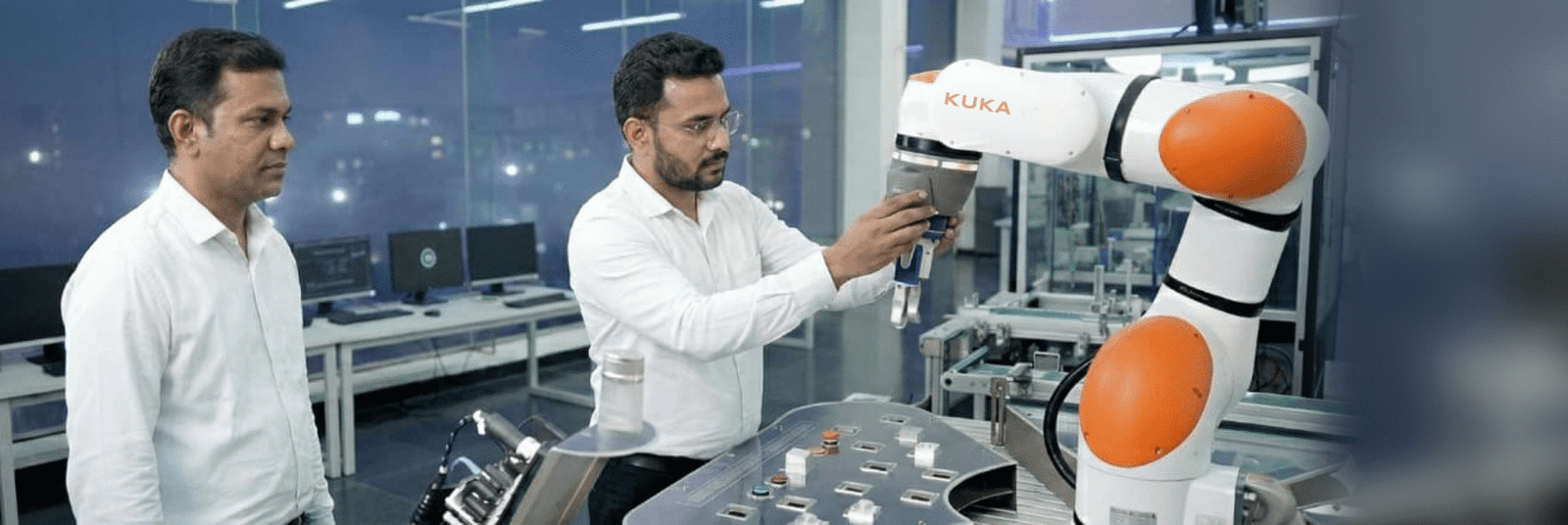
Integrating robotics training in universities bridges the gap between theory and real-world innovation. It equips students with hands-on Industry 4.0 skills, enhances interdisciplinary learning, and builds a future-ready workforce capable of designing, automating, and optimizing intelligent systems across manufacturing, healthcare, and research sectors.
Unveiling the Future of Robotics Education
Hytech empowers universities to redefine engineering education through its advanced robotics and automation training ecosystem. From foundational mechatronics kits to full-scale Industry 4.0 smart factory systems, each solution bridges academic theory with industrial practice. Learners gain hands-on experience in PLC programming, IIoT integration, and robot commissioning—skills that align directly with global manufacturing demands. By equipping institutions with modular, scalable training cells, Hytech ensures students graduate ready to innovate, automate, and lead in tomorrow’s connected industries. This transformation begins with one lab—built for the future.
Exploring the Importance of Robotics Education
Robotics education is more than just programming machines—it’s about empowering innovation. By embedding robotics into university curricula, students gain a tangible understanding of automation, control systems, and real-world problem solving. From designing mechatronic prototypes to simulating smart manufacturing processes, they learn to think like modern engineers. Hytech bridges this academic-industry gap with modular robotics training platforms, digital twin technology, and Industry 4.0-ready labs, preparing graduates for evolving global industries where automation and intelligence drive productivity, safety, and sustainable growth across every sector of engineering and technology.
“Hytech’s robotics training transformed our engineering program. Students now design, test, and simulate automation processes independently. It’s incredible to see theoretical learning evolve into practical innovation—bridging education and industry faster than ever.”
— Dr. Priya Rao, Dean of Engineering
Core Skills Gained Explained
Through structured robotics training, students acquire a balance of mechanical design, electrical integration, and software control expertise. They master PLC programming, HMI development, and real-time robot operation—building both technical fluency and analytical thinking. By engaging with Industry 4.0 technologies, learners gain an edge in automation, mechatronics, and smart manufacturing, shaping a generation of engineers ready for tomorrow’s connected industries.