
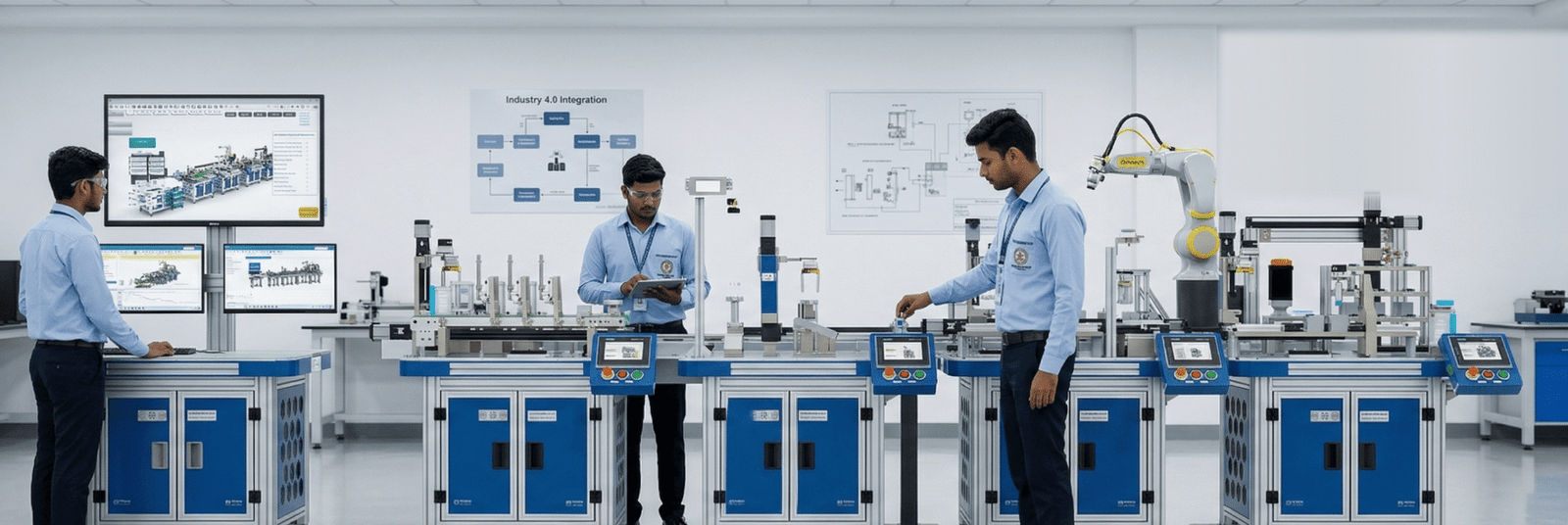
With the rapid adoption of Industry 4.0 technologies in manufacturing industries, technical institutions are facing increasing pressure to prepare students with practical skills in automation, robotics, industrial networking, and smart manufacturing systems.
A leading technical training institute partnered with Hytech Automation to establish a fully functional Industry 4.0 Smart Manufacturing Lab. The objective was to bridge the gap between theoretical knowledge and real-world industrial automation practices by providing students with hands-on experience on a fully integrated smart factory training platform.
The solution implemented included automation systems, robotics, industrial communication networks, and digital twin simulation, enabling students to learn modern manufacturing technologies in a practical environment.
The Challenge
The institute recognized that traditional laboratory setups were no longer sufficient to train students for modern smart factories. While students had exposure to individual subjects such as PLC programming or robotics, they lacked experience in integrated manufacturing systems, which are essential in today’s industry.
Some of the key challenges faced by the institute included:
- Lack of Integrated Automation Systems:
Existing labs had standalone training kits for PLCs or sensors, but students were not able to understand how these technologies work together in a real manufacturing environment. - Limited Exposure to Industry 4.0 Technologies:
Concepts such as Digital Twin, Industrial Internet of Things (IIoT), and smart manufacturing systems were taught theoretically but students had no practical platform to experiment with these technologies. - Gap Between Academic Learning and Industry Requirements: Industries are increasingly adopting automation, robotics, and data-driven manufacturing, but graduates often lack hands-on exposure to integrated systems.
- Need for Advanced Research Infrastructure: Faculty members required a modern automation platform to conduct research in areas such as smart manufacturing, cyber-physical systems, and industrial communication networks.
To address these challenges, the institute decided to establish a state-of-the-art Industry 4.0 laboratory.
The Hytech Automation Solution
To transform the traditional lab into a modern Industry 4.0 training facility, Hytech Automation implemented a Smart Factory training system integrated with Digital Twin technology.
This training platform replicates the workflow of an actual industrial production system and enables students to understand how different automation technologies interact within a manufacturing environment.
The solution included the following integrated technologies:
PLC-Based Automation Control
The system is controlled using industrial PLCs that manage machine operations, process sequences, and communication between different stations.
Students learn:
- PLC programming
- Ladder logic development
- Industrial automation control strategies
- Machine sequence control
Robotics Integration
Industrial robotic systems are integrated into the smart factory setup to simulate real manufacturing processes such as material handling, assembly, and sorting.
Students gain exposure to:
- Robot programming
- Pick-and-place automation
- Robotic workflow integration
- Human–robot collaboration concepts
Sensors and Actuators
The system includes multiple industrial sensors and actuators to replicate real production environments.
Students work with:
- Proximity sensors
- Vision systems
- Pneumatic actuators
- Servo motors
- Conveyor systems
This allows them to understand real-time machine sensing and actuation in automation systems.
Digital Twin Simulation
One of the most innovative features of the lab is the Digital Twin platform.
A digital twin is a virtual model of the physical smart factory that replicates the behavior of the real system.
Using the digital twin environment, students can:
- Simulate production processes
- Test automation programs
- Validate control logic
- Identify system errors before real implementation
This approach reduces risk, saves time, and provides a safe environment for experimentation.
Industrial Networking and IIoT
The system also includes industrial communication networks that enable machine-to-machine communication.
Students learn about:
- Industrial Ethernet
- PLC networking
- Data acquisition
- IIoT connectivity
- Smart factory data monitoring
This helps students understand how modern factories collect and analyze data for improved productivity.
Implementation
The Smart Manufacturing Lab was implemented in multiple stages:
Step 1 – Lab Infrastructure Setup
The automation equipment, robotic systems, and smart factory modules were installed in the laboratory environment.
Step 2 – System Integration
Different subsystems such as PLCs, robots, sensors, conveyors, and digital twin software were integrated into a unified training platform.
Step 3 – Software Configuration
Industrial software tools were configured for PLC programming, digital twin simulation, and system monitoring.
Step 4 – Faculty Training
Faculty members were trained on the operation of the smart factory system to effectively deliver Industry 4.0 training to students.
Step 5 – Student Training Programs
Structured training modules were introduced for students covering automation, robotics, smart manufacturing, and digital twin applications.
Results
After the successful implementation of the Smart Manufacturing Lab, the institute observed significant improvements in student learning and technical skill development.
Practical Learning of Smart Manufacturing
Students gained hands-on experience with integrated manufacturing systems rather than learning individual technologies separately.
Exposure to Digital Twin Technology
Students learned how to simulate and validate automation processes using digital twin technology before implementing them on real systems.
Improved Automation and Robotics Skills
Students developed practical skills in PLC programming, robotics, sensor integration, and industrial communication.
Enhanced Faculty Research Opportunities
Faculty members began using the smart factory system for research in areas such as:
- Smart manufacturing systems
- Cyber-physical systems
- Industrial automation
- Digital manufacturing technologies
Impact
The Industry 4.0 Smart Manufacturing Lab significantly transformed the learning environment of the institute.
Industry-Ready Graduates
Students graduating from the institute now have hands-on experience with technologies used in modern smart factories.
Advanced Technical Training
The lab provides a platform for training in:
- Industry 4.0
- Industrial automation
- Robotics
- Smart manufacturing systems
Center for Innovation and Research
The facility has become a hub for innovation where students and faculty collaborate on automation and digital manufacturing projects.
Strengthened Industry Collaboration
The institute can now collaborate with industries for training, research, and skill development programs.
Conclusion
By implementing the Industry 4.0 Smart Factory with Digital Twin solution from Hytech Automation, the institute successfully created a modern training ecosystem that aligns academic education with industrial technology trends.
The smart manufacturing lab now serves as a center of excellence for Industry 4.0 education, empowering students with the knowledge and practical skills required for the future of manufacturing.
“Hytech Automation transformed our learning with real Industry 4.0 systems, building strong practical skills in robotics, PLCs, and digital twin technologies.”
— Dr. Amit Kulkarni, Head of Mechanical Engineering Department