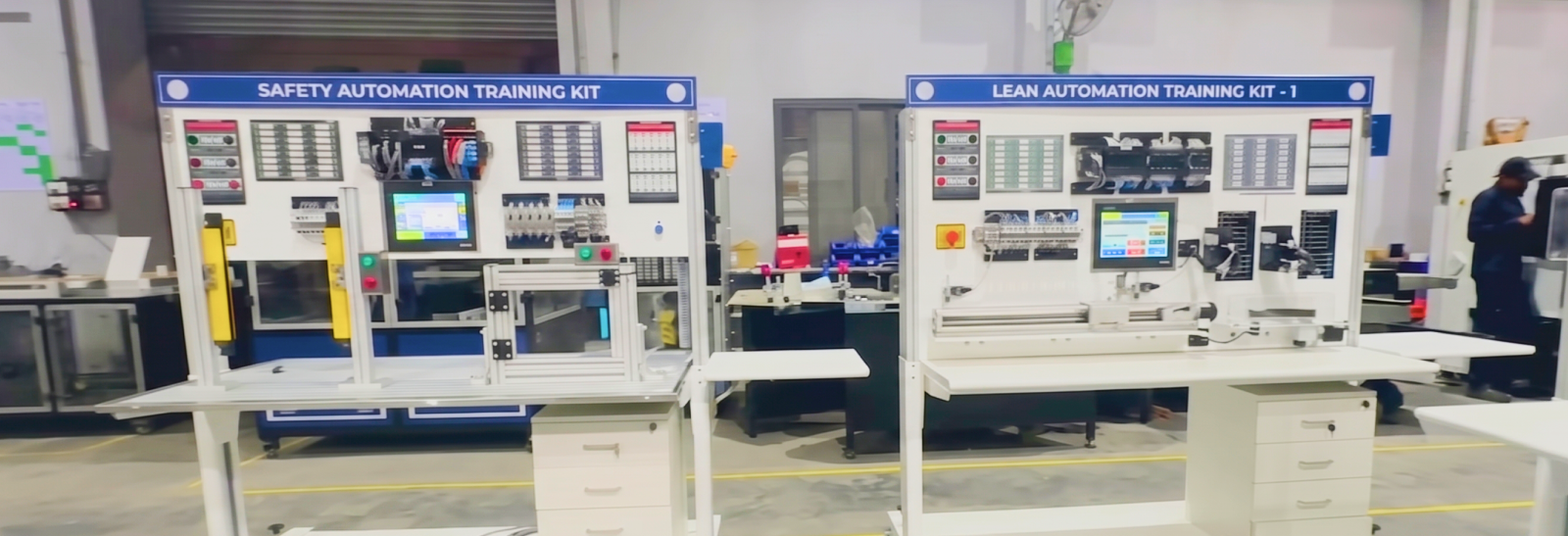
In collaboration with Omron, Hytech Automation has successfully established a state-of-the-art Industry 4.0 Automation Training Centre at IIT Roorkee, enabling industry-aligned skill development.
Industry Challenge
In today’s rapidly evolving industrial landscape, driven by Industry 4.0, smart manufacturing, and digital transformation, a significant gap exists between academic learning environments and real-world industrial requirements.
Most educational institutions continue to rely on theory-based teaching methodologies or isolated laboratory setups, which do not adequately reflect the complexity of modern automation systems. As a result, students often lack exposure to:
- Integrated automation systems combining PLC, motion control, robotics, vision, and process automation
- Real-time industrial communication protocols and smart sensing technologies such as IO-Link and IIoT
- Multi-disciplinary workflows that simulate actual manufacturing environments
- Practical understanding of system integration, troubleshooting, and industrial safety standards
Additionally, conventional training setups are often fragmented, where individual components are taught independently without demonstrating how they function together within a complete automated system.
This leads to a critical challenge:
Graduates are not fully industry-ready, lacking hands-on experience in integrated automation systems.
Recognizing this gap, Omron Automation India Pvt. Ltd., a global leader in industrial automation, initiated a strategic effort to strengthen industry–academia collaboration.
The objective was to enable institutions to adopt real-world automation technologies and create learning environments aligned with modern industrial practices.
At Indian Institute of Technology Roorkee, the need for an advanced, integrated training platform was identified due to:
- Limited access to comprehensive industrial automation systems
- Existing laboratories focused on isolated components rather than integrated solutions
- Lack of exposure to advanced automation technologies in sensing, control, and safety
- Absence of platforms demonstrating end-to-end smart manufacturing workflows
- Limited opportunities for students to gain hands-on experience in multi-technology integration
This resulted in a clear gap between academic training and industry expectations.
To address this challenge, Omron partnered with Hytech Automation as a design, manufacturing, and system integration expert to establish a comprehensive Industry 4.0 training centre.
Hytech Automation translated Omron’s technological vision into a fully integrated, modular training ecosystem by:
- Designing custom automation training kits aligned with industry applications
- Manufacturing industrial-grade modular workstations
- Integrating multiple technologies into a unified platform, including:
- Motion control systems
- Smart sensing (IO-Link enabled devices)
- Machine vision systems
- Robotics and handling applications
- Industrial safety systems
- Process automation modules
- Developing a system architecture that simulates real industrial production workflows
The result is a smart factory-oriented training environment that enables:
- Hands-on learning with real industrial automation technologies
- Understanding of end-to-end manufacturing processes
- Skill development in multi-disciplinary automation systems
- Improved alignment with industry requirements and employability standards
This initiative successfully transforms traditional learning into an application-driven, industry-aligned training experience.
Training Kit Descriptions
- Lean Automation Kit – Servo Motor System
This kit is designed to provide hands-on training in precision motion control using servo technology. It consists of a rotary indexing table integrated with a servo motor and encoder feedback system, along with a linear slide driven by a ball screw mechanism.
- Servo Motor: A high-performance motor equipped with a permanent magnet rotor. Unlike standard motors, it uses a feedback loop to maintain precise control over position, speed, and acceleration.
- Encoder: A rotary sensor mounted on the motor shaft. It converts the angular position or motion of the shaft into digital signals, allowing the controller to know the motor’s exact location within a fraction of a degree.
- Rotary Indexing Table: A mechanical device used to rotate a workpiece to a fixed set of positions. It uses high-precision bearings to ensure the table stops at the exact same coordinates every time.
- Ball Screw & Linear Slide: A mechanical assembly where a threaded shaft (screw) provides a helical raceway for ball bearings. It translates the motor’s rotational torque into linear thrust with extremely low friction and zero backlash.
The system enables learners to understand:
- Servo Fundamentals: Understanding the core concepts, working principles, and operation of servo motors.
- PLC Integration: Learning how to program and integrate servo systems with a PLC.
- Control Modes: Mastering different servo modes of operation and closed-loop feedback systems.
It simulates real industrial applications such as indexing tables, packaging systems, and assembly operations.
- Lean Automation Kit – AC Motor & VFD System
This kit focuses on motor control and drive technology, featuring an AC motor integrated with a Variable Frequency Drive (VFD) and a temperature control module.
It enables learners to study:
- VFD Operations: Understanding the working principles of a Variable Frequency Drive (VFD).
- Speed & Torque Control: Learning how to control motor speed and torque variations via a VFD.
- System Integration: Integrating AC drives with PLC systems.
- Energy & Process Control: Studying energy-efficient motor operation and process control using temperature feedback via a Peltier modul
Widely applicable in industries such as conveyors, pumps, fans, and process systems.
- Advanced Automation Kit – Complex Motion System
This is a multi-axis motion control system comprising X, Y, and Z servo-driven linear axes, designed to simulate advanced automation applications.
- XYZ Gantry/Cartesian Robot: A configuration of three linear axes mounted perpendicular to each other.
- Linear Actuators: Each axis (X, Y, Z) has its own dedicated drive (usually a ball screw or belt drive) and motor to allow independent movement.
- Limit Switches & Home Sensors: These are physical or inductive sensors located at the boundaries of the machine. “Home” establishes the (0,0,0) coordinate, while “Limit” sensors act as a hard-stop to prevent mechanical over-travel.
Key learning areas include:
- Coordinated Motion: Mastering multi-axis interpolation and coordinated movement across X, Y, and Z axes.
- Path Programming: Understanding CNC and plotter-based operations.
- Motion Safety: Implementing hardware safety features such as limit switches (POT/NOT) and motion safety logic.
- Robotics Logic: Developing a foundational understanding of robotics motion logic and precision automation.
Ideal for understanding robotics motion logic, CNC systems, and precision automation applications.
- Advanced Automation Kit – IO-Link & Sensor System
This kit provides hands-on experience with smart sensing technologies and industrial communication protocols, particularly IO-Link-based devices.
It includes multiple sensor mounting arrangements.
- IO-Link Master: An industrial gateway (often IP67 rated) that acts as the communication hub. It translates the IO-Link protocol into a standard fieldbus like EtherNet/IP or PROFINET.
- Point-to-Point Communication: Unlike traditional wiring where one wire equals one signal, IO-Link uses a 3-wire unshielded cable to transmit process data, device parameters, and detailed events/diagnostics simultaneously.
Learners gain knowledge in:
- Communication Protocols: Understanding the operation and configuration of an IO-Link master.
- Smart Diagnostics: Configuring smart sensors and utilizing remote diagnostics for system health monitoring.
- Data Exchange: Implementing IO-Link communication for real-time data exchange between field devices and the PLC.
- Sensor Logic: Developing sensor-based control logic for automated systems.
Represents modern Industry 4.0-enabled sensing systems used in smart factories.
- Machine Safety Training Kit
This kit is designed to demonstrate industrial safety systems and standards, integrating safety components within a controlled environment.
It helps learners understand:
- Safety Circuitry: Understanding the design and implementation of safety circuits and protection mechanisms.
- Emergency Systems: Learning to integrate emergency stop systems and safety interlocks.
- Risk Mitigation: Practicing safe machine operation and understanding industrial compliance and risk reduction.
Critical for industries focusing on operator safety, compliance, and risk reduction.
- Machine Vision Kit
The Machine Vision Kit includes a conveyor system integrated with vision inspection setup, along with controlled lighting and mounting arrangements.
Key learning outcomes:
- Object Detection: Learning the fundamentals of object detection and automated inspection using industrial cameras.
- Quality Control: Implementing vision-based sorting and quality control logic on a moving conveyor.
Simulates real-world applications such as defect detection, sorting, and inspection in manufacturing lines.
- Robot Training Cell
This is a comprehensive robotic automation system designed for hands-on training in industrial robotics and system integration.
It includes:
- Robotic workstation with tool changer and grippers
- Multiple application tables:
- Color-based sorting (IO-Link)
- RFID-based sorting
- Assembly operations
- Vision-based sorting (future-ready)
Learners can perform:
- Robot Programming: Mastering both online and offline robot programming techniques.
- System Integration: Integrating a robotic arm with PLC systems and external sensors.
- Advanced Handling: Performing complex pick-and-place, sorting, and assembly tasks.
- Multi-Technology Sorting: Learning to use IO-Link color sensors and RFID for intelligent part sorting.
Represents a complete robotic manufacturing cell used in modern industries.
- Process Automation Kit
This kit is designed to simulate process industry applications using a dual-tank system with control mechanisms.
Learners can study:
- Process Programming: Learning PLC programming specifically for process-heavy industries.
- HMI Design: Designing Human-Machine Interface (HMI) screens for process monitoring.
- Closed-Loop Control: Studying feedback-based control systems for level and flow regulation.
- Parameter Monitoring: Learning to monitor and adjust critical process parameters in real-time.
Applicable to industries such as oil & gas, water treatment, and chemical processing.